
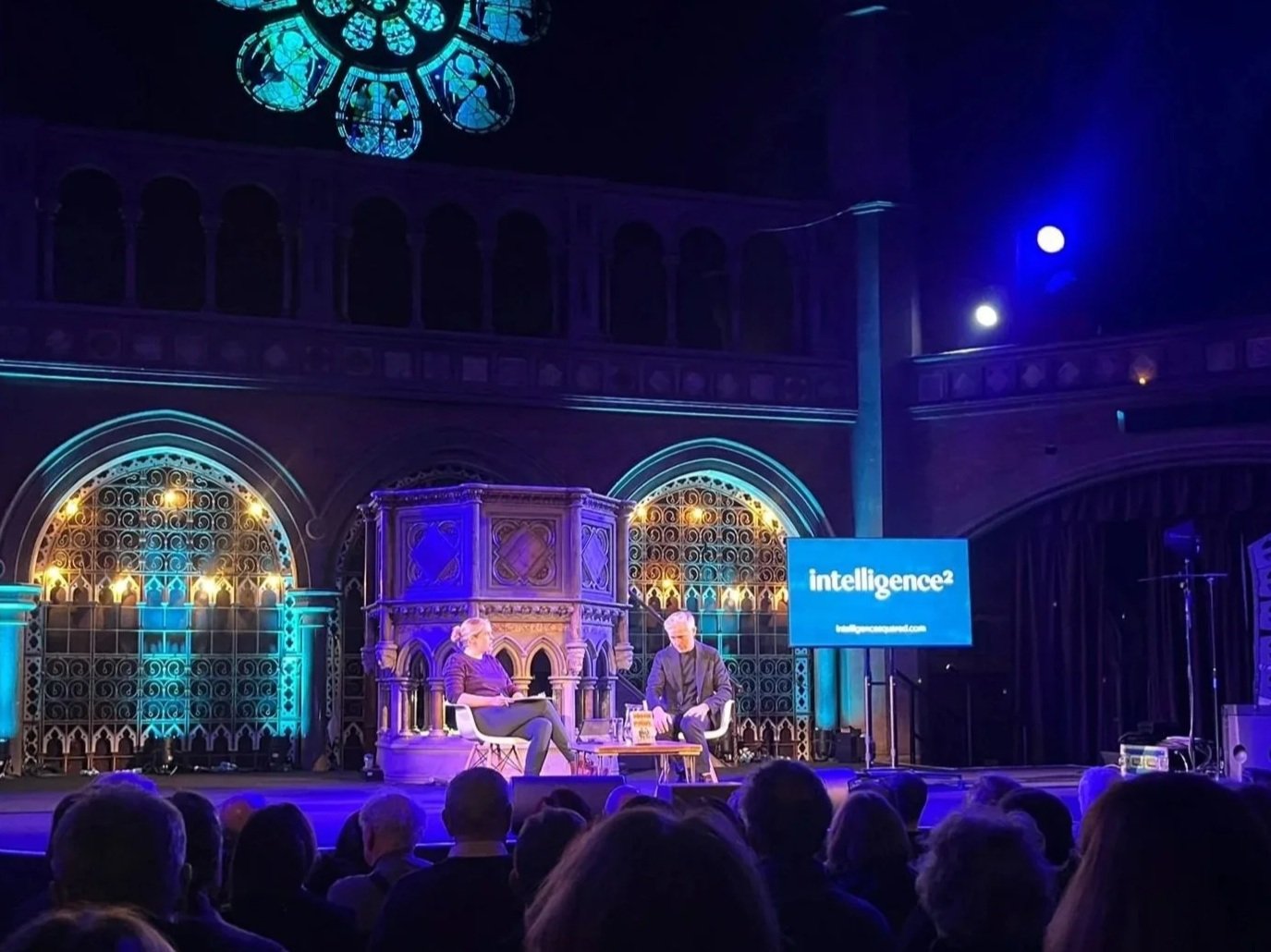
Helen Lewis interviews Ian Leslie about his book, John & Paul: A Love Story in Songs
As a creative agency specialising in learning-first children’s songs, we are forever fascinated by the topic of creativity .
So, as part of our Creativity in focus series, we recently attended a local talk on one of the greatest songwriting creative partnerships the world has ever seen – that of John Lennon and Paul McCartney.
The Q&A was with Ian Leslie who was discussing his brilliantly insightful book, John & Paul: A Love Story in Songs, with Helen Lewis asking the questions, and hosted by Intelligence Squared at Union Chapel, Islington. Below are some of our reflections and takeaways from the event.
Relationships’ relationship to creativity
The book is an exploration of the strength and intricacy of the bond between John and Paul, and how inseparable this was from their creative output. Drawn together by a shared passion for music and sense of humour, they also shared the pain of having both lost their mothers at a young age. In the book, Leslie explores just how uniquely interconnected they became.
For example, as they take turns to sing lines in a song, he observes, John and Paul effectively step into a shared subjectivity. As well as writing songs face-to-face with their guitars, Leslie also describes how they would sometimes intentionally stare into each other's eyes as they wrote, an act of psychological intimacy that requires a surprisingly raw level of vulnerability and boundary collapse.
The hours Lennon and McCartney spent together, their shared passions and pain, and the unique bond that these two individuals developed resulted in a familiarity that no doubt enabled the elevation of their creative flow.
Of course, the tension between their opposites is widely acknowledged too and Leslie speculated on the role this played in their creative output. While their differences often served complimentary functions, as well as being a source of inspiration, the tension between them also fuelled a competitive rivalry that probably propelled their songwriting.
When viewed in the overall context of their songwriting output, it’s a reminder of the gifts that the differences between us can offer (sometimes!). It can take the contrast of another to provoke the best out of us or to shine a light on what we might miss, as well as fill in the gaps in our strengths.
Overall, this beautiful and moving exploration of friendship and music offers a chance to reflect on the influence of relationships on creativity – how they can inspire, provoke, encourage, and provide the conditions to cultivate it – and music’s role in social bonding (for more on the science of this, check out the paper Music, Feelings and the Human Brain by Antonio Damasio and Assal Habibi of the Brain and Creativity Institute).
When it comes to applying this takeaway to developing learning-first content for your educational project don’t worry, we’re not going to insist you stare into our eyes! But as creative specialists, we do understand the overall message here – that is how important relationships are to getting the best outcomes for your project and therefore the importance of nurturing these relationships with both you, our clients, as well as our talent talented team.
The role of playfulness in creativity
Secondly, as we saw in Get Back, it emerged again just how central a shared sense of humour and playfulness were to John and Paul’s songwriting practice (something we discussed in a previous blog). Interestingly this is something our lead children’s songwriters at Creative Listening, Luke and Tom, cite as important too, and an environment we try to cultivate in our concept development service.
In fact, neuroscience research is starting to suggest that this playfulness could be an essential component of creativity. More and more research highlights the role of the default mode network, which is engaged when the brain is at rest or engaged in a non-demanding task, in creativity (there’s much more to be discussed on this topic, but we’ll save it for another blog).
Finally, towards the end of the event, Leslie mentioned how charmed he always is by how much children love The Beatles. We understand the power of this childlike enjoyment and it’s something we aim for in our educational children’s songs. Because who says learning can’t be fun?
Need our educational and ELT children’s songs?
Want to find out more about concept development service where we can help you to develop the creative concept for your educational project?
Buy a copy of John & Paul: A Love Story in Songs on Bookshop.org.
Find out more about Ian Leslie via his website and his Substack.
Blog by Aimy Marling and Luke Vyner.